
News
Lake District Management Plan: a fork in the road
Our response to the Draft Lake District Management Plan consultation focuses on our key areas of concern about the plan, in relation to how it proposes to deal with transport, regenerative tourism, housing and communities.
We have submitted our response to the Draft Lake District Management Plan consultation.
Our response focuses on our key areas of concern about the plan, in relation to how it proposes to deal with transport, regenerative tourism, housing and communities.
With the Lake District National Park Partnership (LDNPP) (1) having put its draft Management Plan 2026-31 out for public consultation, Friends of the Lake District is calling for amendments to the Plan so that it becomes as genuinely transformative as the challenges facing the Park require.
For Michael Hill, CEO of Friends of the Lake District, “This is a real fork in the road moment for the Lake District. The draft Plan conveys strong ambitions but falls short in its objectives. In effect, it recognises what is needed, but baulks at attempting to deliver it. Unless a stronger transformational intent comes through in the Plan’s Objectives and Targets, we risk a slow drift into a Lake District of overwhelmed infrastructure, degraded landscapes and hollowed out communities”.
Transport – the choice laid bare
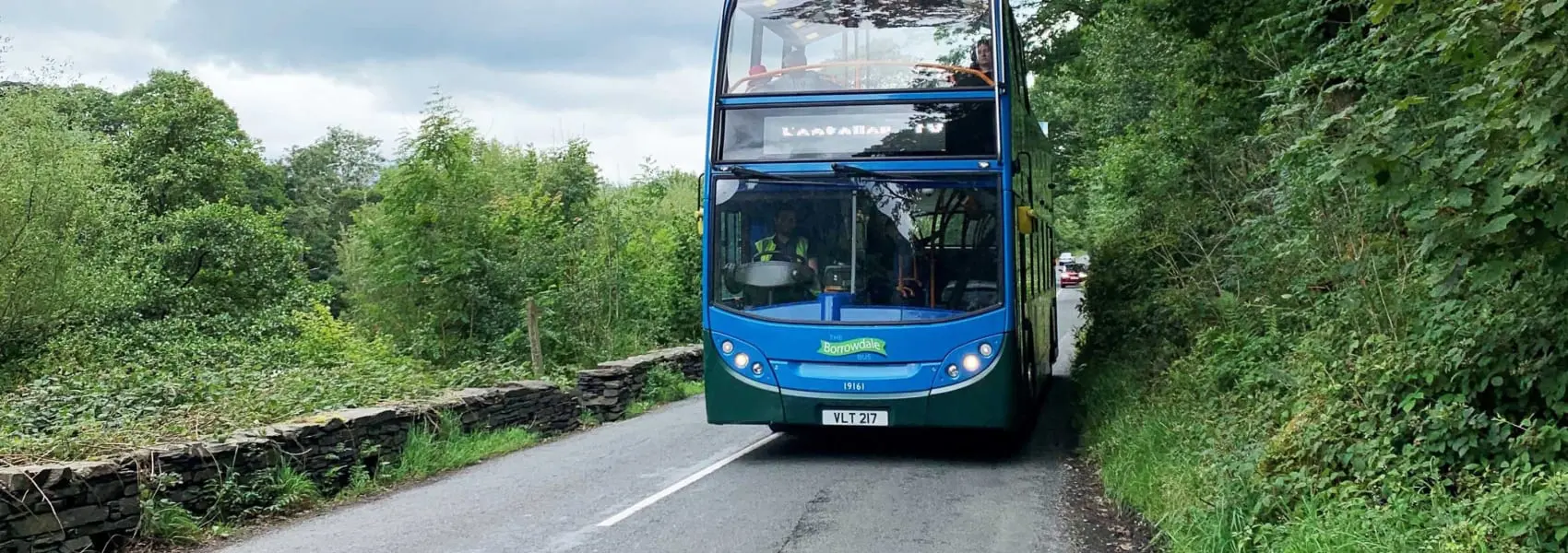
The vast majority of visitors to the Lake District come by private vehicle and travel around by private vehicle. This leads to congestion and unauthorised parking that damages verges and blocks access, even before the impact on the climate is considered. The default to use private transport harms nature, frustrates locals and compromises the enjoyment of the landscape for visitors themselves.
In this context, a Task & Finish Group was formed as an input to the LDNPP planning process with a remit to reflect on how to design, deliver and fund a sustainable transport system. The authors of a report commissioned by the Group concluded that ‘the Partnership faces a choice: whether it wishes to try to work towards the kind of systemic change in the way people travel around the Park or whether it prefers to continue the current slow, incremental approach, which although constructive, will not deliver systemic change’. In considering whether to incorporate the Group’s conclusions into the draft Plan, the Partnership chose the path of slow, incremental change. It agreed an objective to ‘improve integrated sustainable travel and reduce dependency on private vehicles by working with relevant authorities to create and deliver a plan for improvements in sustainable and active travel’, with the crucial qualifier ‘transformational’ – i.e. transformational improvements – rejected. This runs contrary to the existing Management Plan and the Park’s own Smarter Travel plan, which has the stated aim to “catalyse transformational change in the way people get to and around the Lake District”. As such, it represents a regressive step towards a weaker vision for change.
Housing – strong action needed on holiday lets
Independent research commissioned by Friends of the Lake District shows that more than 4,500 properties capable of being used as permanent dwellings in the National Park are used as self-catering visitor accommodation units. At full capacity, the self-catering visitor accommodation population is as much as 60% of the total permanent residential population across the Park as a whole, while in some areas – notably Ambleside and central Keswick – the number of self-catering visitor accommodation units is more than double that of permanent residential dwellings.
On paper, the Plan signals a clear intent to address the proliferation of holiday lets. It notes that ‘high house prices, high numbers of second homes and holiday lets, and a lack of affordable housing are making it hard for young people and families to stay in, or move to, the Lake District’. It aims to ‘support appropriate ways to tackle excessive numbers of empty and, or holiday homes where this occurs’ and ‘ensure new homes contribute to community vibrancy by requiring their permanent occupancy, as part of the planning consent’. This translates into an objective to ‘help rural communities to be sustainable and vibrant by… increasing the supply and mix (size, ownership/rent) of affordable or occupancy-restricted homes and controlling the proportion of houses used for second homes and short-term holiday letting’.
The crux is whether, in the face of stiff government targets for house-building, the emphasis in practice is put on delivering more homes rather than on bringing empty or underused properties back into permanent residential use. Current experience shows this simply does not work. (2) For Michael Hill, “the relentless surge in the conversion of homes into holiday lets means that those born in Cumbria cannot afford their own home in the county. The lack of a permanent population is rendering some villages unviable for small shops and other amenities. It is imperative that all short-term lets are registered and licenced and that the Plan targets a decrease in the proportion of homes in non-permanent occupancy rather than the current, less ambitious ‘no increase’”.
Tourism – the heart of the matter
The Plan is liberally sprinkled with references to ‘regenerative tourism’, defined as a form of tourism that ‘restores and renews natural resources rather than depletes them, focusing on sustainable and equitable growth while prioritising environmental and social wellbeing’. If meant seriously, this would constitute a paradigm shift in both supply and in demand. Holiday providers would need to operate differently – cutting their own emissions and steering clear of tourism ‘offers’ that are out of tune with the Park’s special qualities – and the Lake District National Park Authority would need to impose and apply planning rules to make them do so. Visitors themselves would need to understand that their right to access the natural beauty of Cumbria comes with a responsibility to ensure that, through their visit, the landscape is enhanced for future generations to enjoy. This includes being willing to pay a visitor levy to help keep the Lake District special; that 64% of visitors to the Lake District are willing to pay such a levy offers confidence that many would be.
For Michael Hill, “we’re suffering from an expansionary and extractive form of tourism that takes without giving back, whose profits bring little benefit to local residents and which seems locked into the pursuit of ever more visitors. When the Plan refers to regenerative tourism, the risk is that this is taken to mean a few voluntary initiatives to soften the impacts of tourism without substantially changing the model on which it’s based. This is a Plan for five years. It should lay out a path towards a radical transformation in tourism to the Lake District”.
1 The Lake District National Park Partnership is a multi-stakeholder forum comprising representatives of business, civil society and the two Cumbrian unitary authorities, as well as the National Park Authority itself. It was formed in 2006 because ‘many organisations with a role in the Lake District National Park did not have a real sense of involvement in its management’.
2 A study by Generation Rent showed that between 2019 and 2022 426 new homes were created in the Copeland area of the Lake District but 407 existing homes were converted to commercial holiday lets or second homes in the same period. In effect, an approach centred on house-building ended with a net gain of only 19 new homes.
Share this post
Related posts
Updates from our campaigns, our land, and the people taking action for the Lakes.
Pop up campsite consultation launched
An Article 4 Direction would require camp site operators to submit a planning application where all issues (positive…
Friends of the Lake District project and staff shortlisted for national conservation awards
We’ve been shortlisted for three CPRE Centenary awards.

Photo Competition winners capture the magic of the Lake District in Calendars and Cards
We are delighted to launch our new range of Christmas cards and 2027 calendars, featuring stunning images by…