
Land Manager’s Diary
High Borrowdale extremes
While volunteers dig in at High Borrowdale, Jan reflects on the government’s Land Use Framework and what it might mean for upland hill farmers while the bridge at Dam Mire opens to the public.
High Borrowdale extremes
The government announced it long awaited Land Use Framework last week, the first ever for England. We had previously submitted comments to inform this document that sets out a shared national vision for how the country’s finite land resource should be used – balancing food production, nature recovery, housing, clean energy and climate resilience. Land sits at the heart of almost every major challenge facing the UK: food security, climate change, nature recovery, housing, flood risk, clean energy. Yet these things to date have not been connected altogether.
Sue Pritchard, the Chief Executive of the Food, Farming and Countryside Commission says it is not just about land in a physical sense, but about land use decision making – trying to tackle the silos in government, the gaps between national and local, the fact that for some really critical areas like food production, there are no targets. At the heart of the framework are four key principles:
- Multifunctionality. Land can and should serve more than one purpose at a time – producing food while restoring nature, managing flood risk while improving water quality, generating energy while supporting landscape health.
- Right use, right place. National priorities must be delivered in ways that are sensitive to the specific geography, ecology and communities of each place.
- Adaptive capacity. Whatever decisions are made about land must be capable of adaptation in the face of uncertain futures – sea level rise, increased flood risk, shifting growing conditions. Designing for resilience, not just efficiency, is central.
- Future-ready decisions based on evidence. Critical data sets are often siloed across different departments and organisations, making it difficult and expensive for those making decisions on the ground to access what they need. The framework commits to improving how evidence is gathered, shared and used.
There is a lot to welcome in this document but what impact will it have in reality? It is not a zoning map and doesn’t tell people what to do and where – it is about principles and a process. We will have to wait and see what the impact is, but when public funding is tight or non existent and the green finance market is not really an option for the majority, there is a big question that remains over funding future plans. In terms of the uplands, the framework designates upland areas as broadly less productive for food, which whilst true may be of concern for some people. As Phil Stocker, Chief Exec of the National Sheep Association says: “While we often talk about intensive farming being bad and extensive farming being good, I think what we need is more intensity of management – even in the uplands – rather than intensive farming systems.
The right flock, in the right place, managed in the right way, can deliver serious ecological outcomes. Heavy, mob-grazed animals with active shepherding can benefit biodiversity in ways that set-stocked, low-density grazing does not. Getting the financial and market mechanisms in place to reward that kind of management – whether through agri-environment schemes, biodiversity net gain, or private nature markets – is the central challenge.”
Dam Mire bridge now open
Well the work is pretty much done at Dam Mire, just some new gates to go on. It looks impressive and once the land has settled will green over again. You can now walk between both pieces of land and enjoy the whole. We have put two unusual bird boxes on the underside of the bridge – specially made in Germany, they are the crème de la crème of bird boxes for dippers and pied wagtails who like to nest over water. But the birds are fussy so we may not see any inhabitants for a year or so.
At High Borrowdale
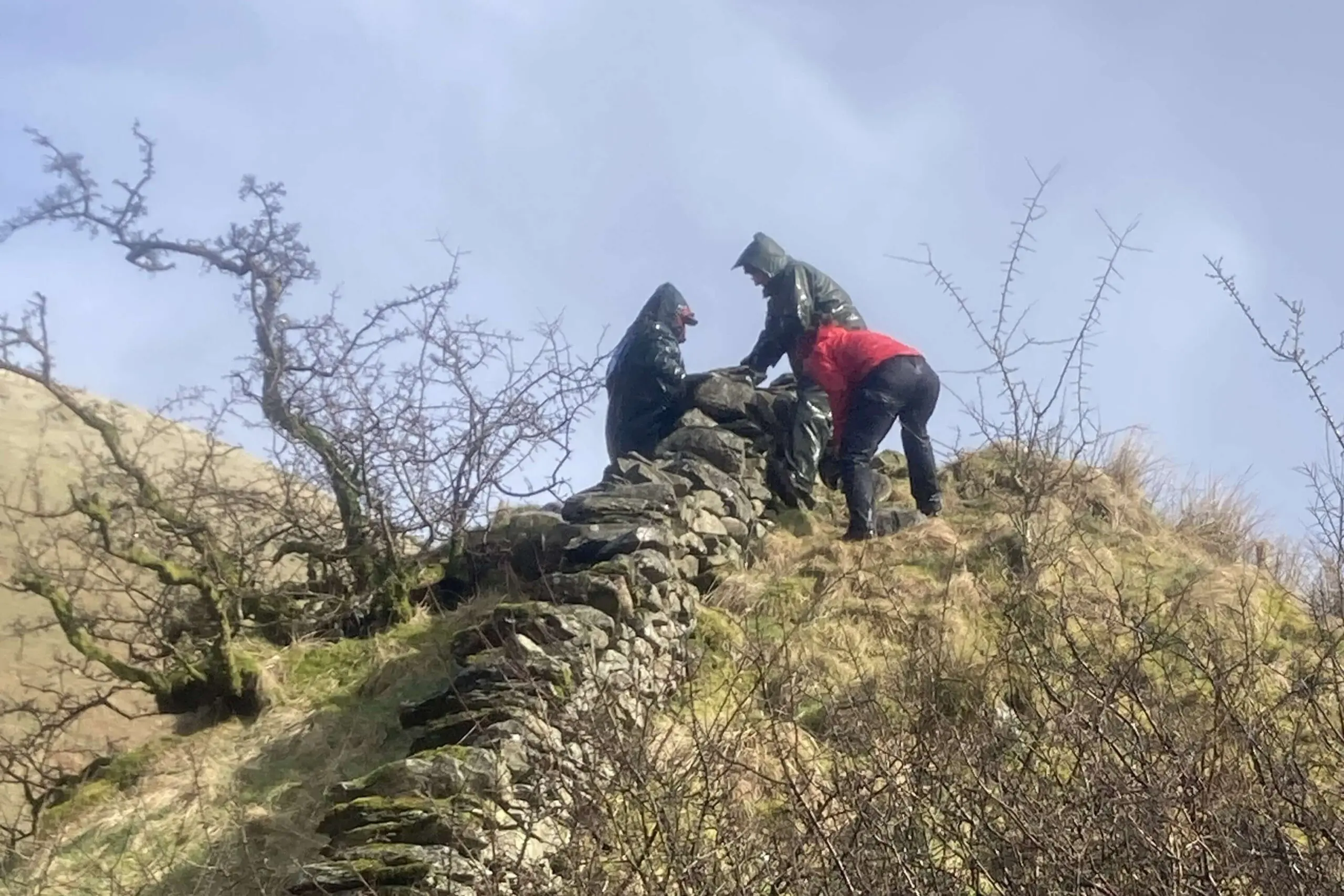
This week we were out with the volunteers at High Borrowdale. This place is the epitome of extremes all round. We had extreme weather, one minute sunshine and the next howling blizzards that hurt any exposed bits of skin. There were extreme tasks as well, lots of fettling and fixing on the go after the winter storms.
We split into three gangs. Those liking a challenge headed off to the top of the land complete with fencing posts, a huge hammer and a big roll of wire to fix a gap at the top wall caused by the beck undercutting the land. It was a difficult location and a difficult fix, but hopefully it will stop the sheep getting in. Roger and John worked tirelessly down below restaking trees and collecting tubes after the recent storms. The rest of us set off around the fell boundaries, trying to think like a sheep who wanted to break into our land. We fixed bits of wall and fence and removed 15 sheep off the land. There were wall gaps to fix, gates to tinker with so they swung properly, drains to unblock of debris, it was a real catch up, fettle and spring clean day. The volunteers gave us a whopping 60 hours of time so a huge thank you to all of them!
Coming up…
We are taking an easter break to eat lots of easter eggs so our next workparty is on 15 April. You may have noticed we have a beautiful new website but hopefully all the links are working. https://www.friendsofthelakedistrict.org.uk/event/mazonwath-workparty/
Hows Wood is Eskdale is on Tue 21 April : https://www.friendsofthelakedistrict.org.uk/event/hows-wood-workparty/
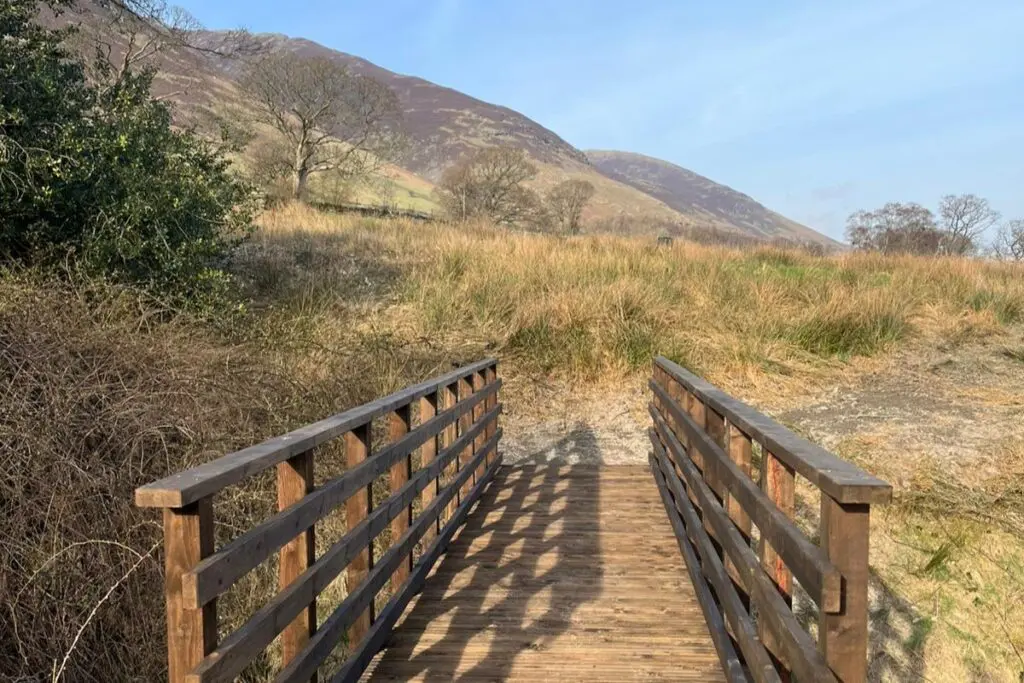
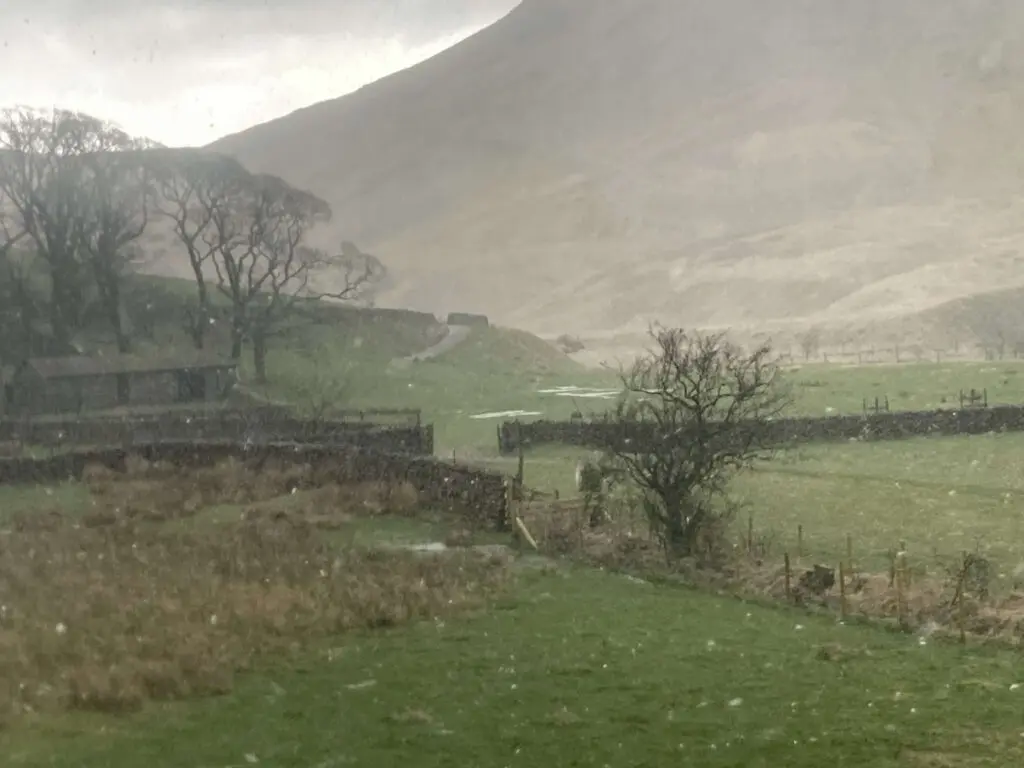
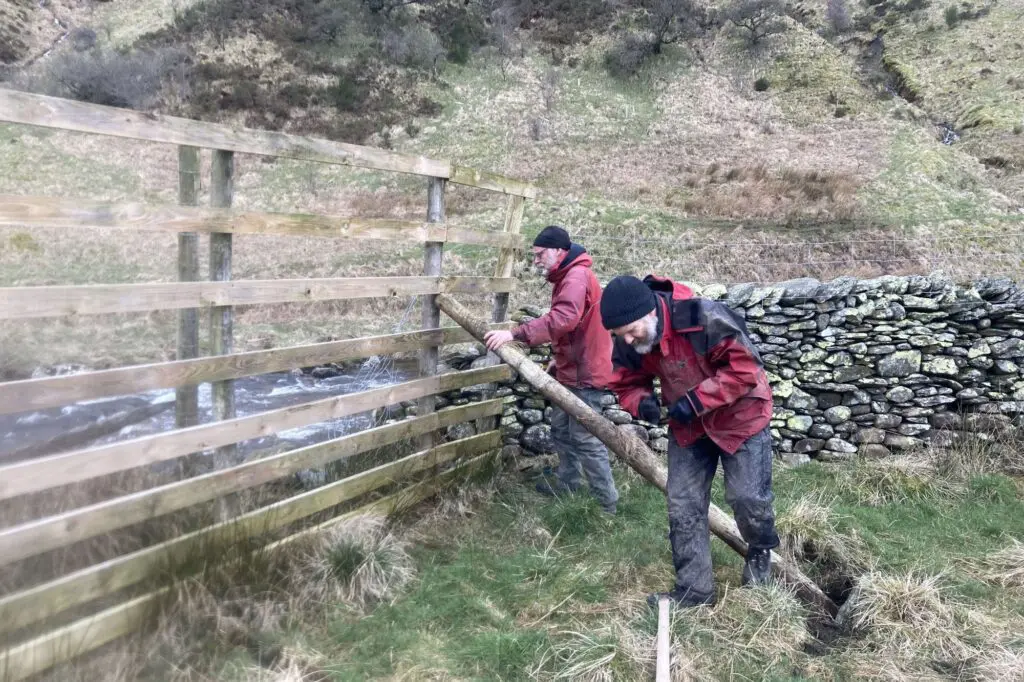
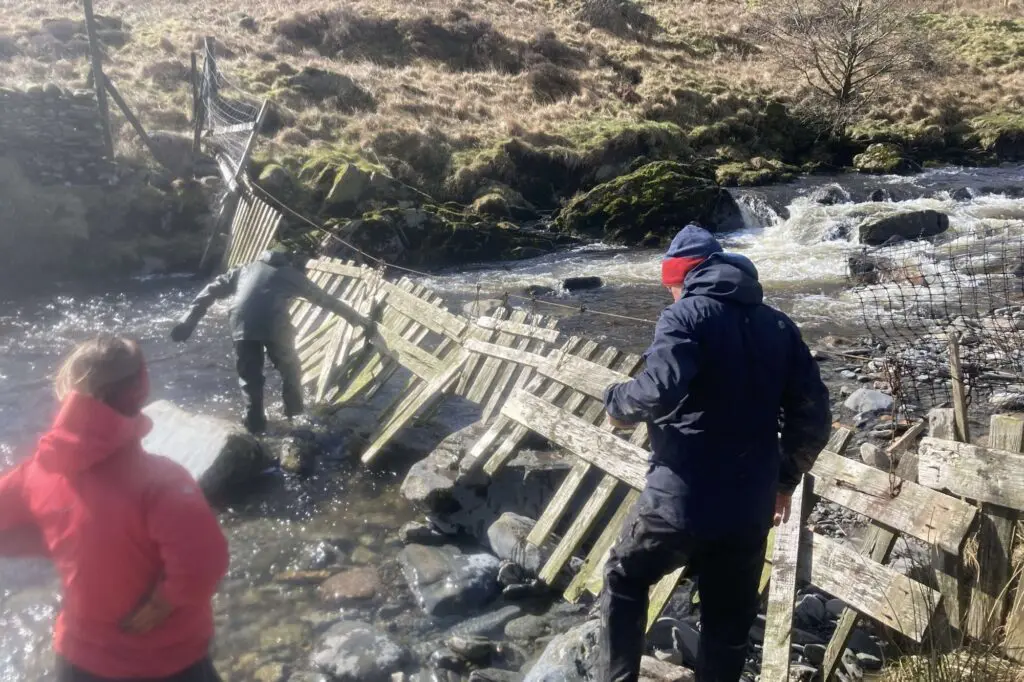
Clockwise from top left: the new bridge at Dam Mire, a snow storm hits High Borrowdale, and volunteers at work on fences and the watergate.
Share this post
Related posts
Updates from our campaigns, our land, and the people taking action for the Lakes.

Our new website
The website as you see it now is just the start. Much of our previous content is temporarily…

Mud, Maud and Mabel
an has some cheeky visitors to her garden while there’s a muddy volunteer day at Mazonwath. Plus the…

The holly, the digger and the hedgehog hope
This week we have been in our beautiful woods in the Rusland Valley, trying to make these woods…