
Land Manager’s Diary
Thinking of the future
Most people think that it is summer time when most organizations such as ours run most of their events.
Thinking of the future
Most people think that it is summer time when most organizations such as ours run most of their events. Whilst that is true, it is going a bit bonkers with us right now with so many exciting events coming up from hedge planting and laying, through to dark skies walks. You can see what we have on the go and book on events here.
Following on from our hugely successful tree planting day in our woods in the beautiful Rusland Valley last week, the trowels were out again this week but on the eastern side of the county. This time we were in our hay meadow restoration field at Mazonwath, next to our own Little Asby Common, near Orton. We were adding some upland hay meadow plants to the meadow as part of the Cumbria Seed Bank project, being run by Cumbria Wildlife Trust. The aim of the project is to re-introduce or bolster 14 rare plant species at selected locations across the county so that they prosper and establish strongholds, and in turn reverse the decline of rare and iconic wild flowers of grassland habitats. Working in conjunction with Kew Millennium Seed Bank, the project is focusing on the collection, storage and sowing of seed from rare and declining grassland species that are found in Cumbria. Seed will be held at the Wildlife Trust’s Cumbria Seed Bank, at Gosling Sike nursery in Carlisle, with the aim to preserve the genetic diversity of native plant species.
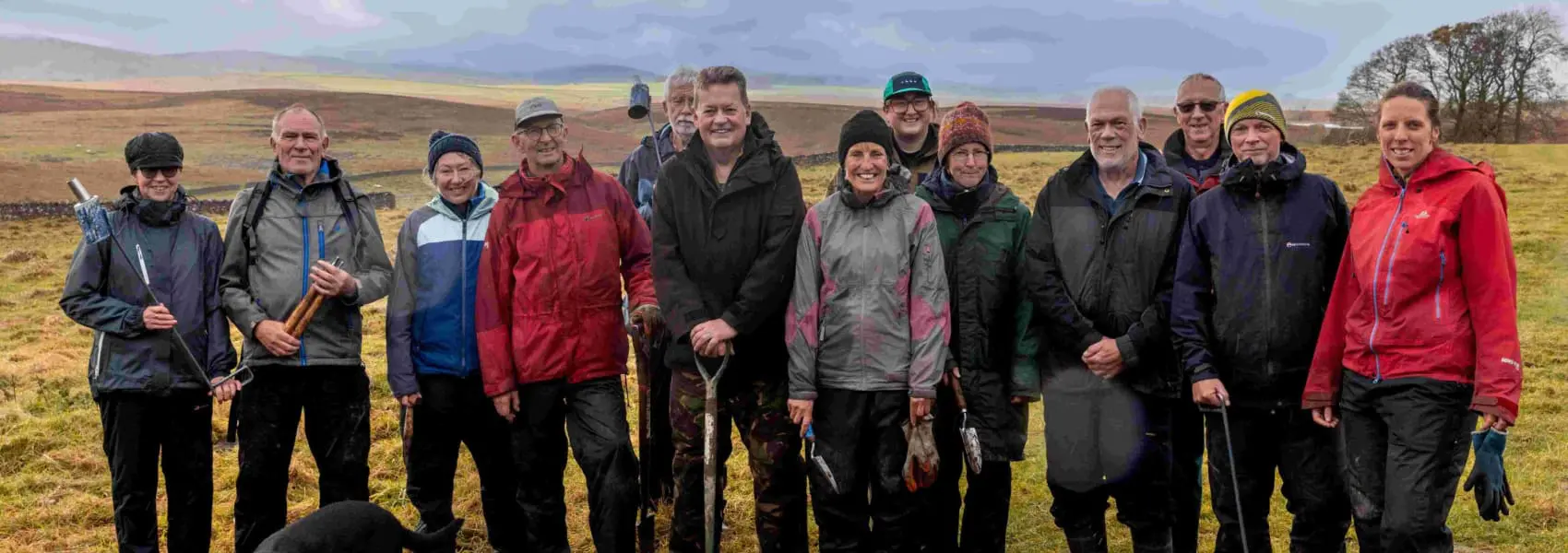
We restored the top field at Mazonwath three years ago as part of our Westmorland Dales Landscape Partnership project. The meadow is doing well in terms of grasses and the herb content, but not so well in terms of hay meadow flowers. The aim of additional planting was therefore to increase the overall diversity of the meadow through additional plug plants of upland hay meadow indicator species plus some less common and rare plants. So for us, we focused on adding plants many of which are familiar from High Borrowdale which included: Black knapweed, lady’s bedstraw, oxeye daisy, red clover, great burnett, meadow cranesbill and so on. In total we added 17 species, totalling way over 1000 plants. This was done by our fantastic volunteers who braved the rain and got down on their knees and got their trowels out. Some people like to plant like a clock or compass, with 4 plants at the 3,6,9 and 12 or n, s, w and e positions of a circle/clock and one in the middle, others opt for groups of 3. Under the guidance of Cath the Grasslands Officer at Cumbria Wildlife Trust we planted in groups of 12, 4 in the middle of the clock an 8 around the edges of the clock. Nature is irregular, so it is always an irregular number in a group! Our grazier has kindly shifted the cows into the next door field so for four weeks there will be no grazing to let the plants settle in, and then it will be management as usual and sit back and wait and see what grows next spring and summer! All very exciting to see what happens and great to be thinking of the future and a seed bank for future generations.
The vols did so well that by lunchtime we had finished! So a few of us stayed on and we managed to complete the job of earlier this month of fettling the ends of the odd shaped bields (shelters) on the common. The cows keep knocking the end stones off by rubbing against them, so it was great to have a bit of time to rebuild them. Lets see how long they last this time! Just time on the way back to put up our newest bit of kit – a people counter at Dam Mire Wood. We have never had anything like this but thought it would be good to get an idea of how many people visit some of our properties and we have chosen Dam Mire for a pilot. We should be able to measure use now and then again once our new bridge goes in and just get an idea of how many people use the land.
Meanwhile the emergency wall gang have been on call out again. They were back over at Middle Bleansley near Broughton in Furness and made a cracking job of fixing some wall gaps on tricky slopes with the added feature of a hog hole – to allow sheep through the wall – to fix. Just as they were over there, a call came in from our neighbouring farmer at Rusland to say the recent storms have brought down two sections of wall – caused by branches flexing and rubbing the wall until it collapses. So the gang are back on call to repair those gaps in future days. Thank goodness we have some good and willing wallers to help us out in these situations. Thanks guys.
Share this post
Related posts
Updates from our campaigns, our land, and the people taking action for the Lakes.
Pop up campsite consultation launched
An Article 4 Direction would require camp site operators to submit a planning application where all issues (positive…
New recruits and celebrations
This week, Jan and our volunteers return to Mazonwath to plant and take care of some dry stone…

Local plans: help shape future development in Cumbria
Our planning officer explains what local plans are and how you can have your say